/29 Subnet Mask (255.255.255.248)
Find which /29 network an IP address is in and list every /29 subnet of a bigger block, with host ranges and broadcasts.
Recent
Your last 10 settings, saved only in this browser. Nothing is uploaded.
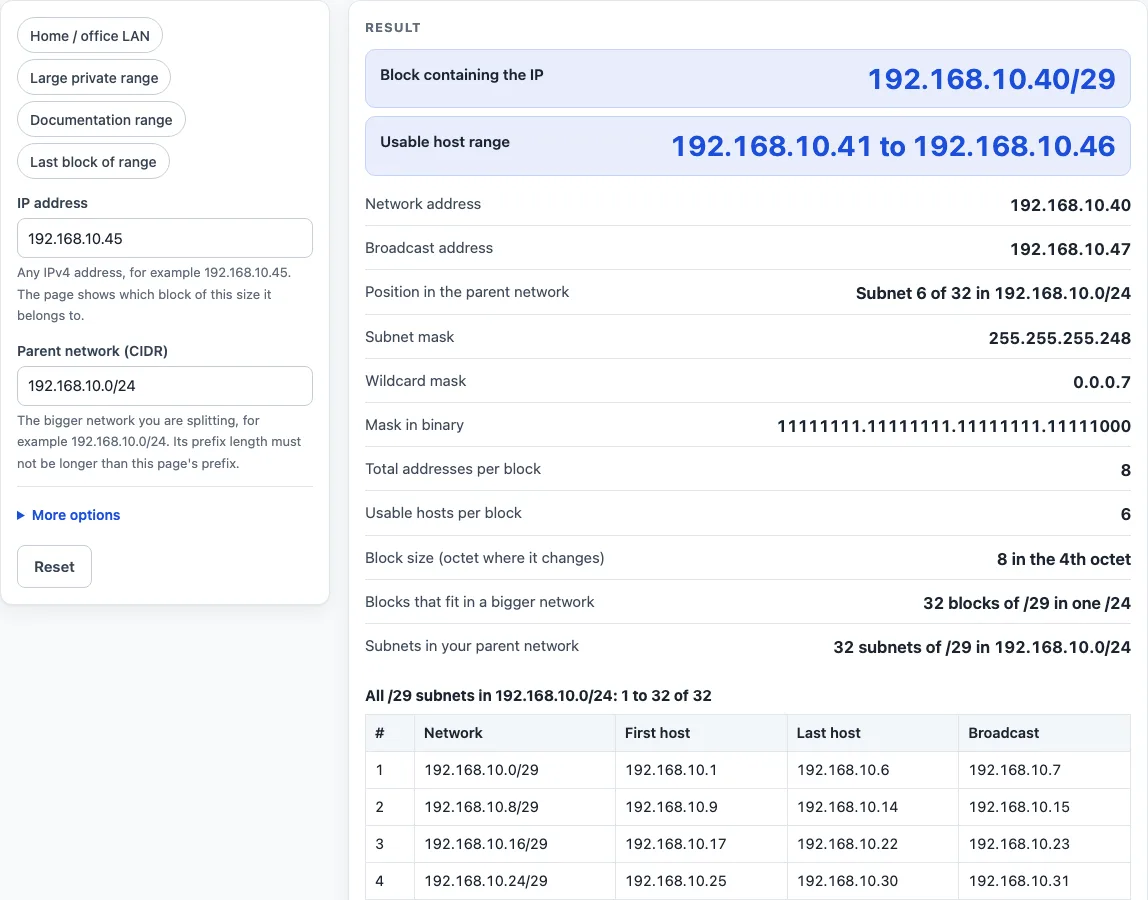
This /29 subnet mask calculator takes an IP address and a parent network, then shows the /29 block that contains the address, its usable host range, and a table of every /29 subnet in the parent. A /29 subnet mask is 255.255.255.248, and each /29 block holds 8 addresses, 6 of them usable hosts. The calculator runs in your browser, it is free, and there is no sign-up. The prefix is fixed at /29, so every result on this page is about /29 blocks, such as splitting 192.168.10.0/24 into 32 small blocks or checking which block a device belongs to.
Its wildcard mask is 0.0.0.7.
Each /29 starts on a multiple of 8 in the last octet.
How to use the /29 subnet mask calculator
- Type an IP address in the “IP address” box, for example 192.168.10.45. Leading zeros such as 010 and values above 255 are rejected. You can also type a prefix, such as 192.168.10.45/29, and only the address part is used.
- In “Parent network (CIDR)”, type the bigger network you want to split, for example 192.168.10.0/24. Its prefix must be 29 or shorter, or the tool shows an error.
- Read the first result. It is the /29 block containing your IP, with its usable host range.
- Check the detail rows for the network address, broadcast address, position of the block in the parent, mask, wildcard, binary mask and totals.
- To see a different part of the table, open “More options” and type a number in “Start the table at subnet number”. Typing 257 shows subnets 257 to 512. The default is 1.
- Scroll the table to find every /29 subnet of the parent, with its first host, last host and broadcast address.
- Or click a preset chip, such as “Home / office LAN”, to fill in an IP and a parent network for you.
The result updates as you type. “How it was calculated” under the result shows the formula, the values substituted and the answer. “Copy result” copies the result lines with a link, “Copy link” copies a page address that stores your inputs, and “Print / save as PDF” prints a one-page record. “Reset” restores the starting example.
What is the /29 subnet mask?
A /29 prefix keeps the first 29 bits of the address for the network and leaves 3 bits for hosts. Written out, the mask is 11111111.11111111.11111111.11111000, which is 255.255.255.248 in dotted decimal; the wildcard (inverse) mask used in router access lists is 0.0.0.7. Each /29 block holds 2^3 = 8 addresses. The first is the network address and the last is the broadcast address (RFC 950), so 6 are usable hosts.
How do you find the /29 subnet of an IP address?
The mask stops being 255 in the fourth octet, and the block size there is 256 − 248 = 8. Round that octet of the address down to a multiple of 8, keep the octets before it and set the octets after it to 0. For 192.168.10.45, the fourth octet is 45; 45 ÷ 8 rounds down to 5, and 5 × 8 = 40. The network is therefore 192.168.10.40/29, the usable hosts run from 192.168.10.41 to 192.168.10.46, and the broadcast address is 192.168.10.47.
How many /29 subnets fit in a larger network?
Each step of one bit doubles the count, so a /24 holds 2^(29 − 24) = 32 subnets of size /29. In 192.168.10.0/24 they start at 192.168.10.0 and go up in steps of 8 in the fourth octet, to 192.168.10.248/29; 192.168.10.40/29 is number 6. The table on this page lists them with their first host, last host and broadcast address, 256 rows at a time.
How does a /29 compare with the sizes next to it?
One bit shorter, a /28 doubles the block to 16 addresses (14 usable hosts); one bit longer, a /30 halves it to 4 addresses (2 usable hosts). Two neighbouring /29 blocks can be joined into one /28 only when the first of them starts on a multiple of 16 in the fourth octet — 192.168.10.32/28 contains 192.168.10.32/29, 192.168.10.40/29.
How is a /29 written in different configurations?
The same mask appears in several forms depending on the device or file: CIDR notation /29 (most routers, cloud consoles and firewalls), dotted decimal 255.255.255.248 (older interface settings, DHCP), hexadecimal 0xFFFFFFF8 (some Unix tools such as ifconfig on BSD), and the wildcard 0.0.0.7 in router access lists and OSPF network statements. They all describe the same 8-address block.
Where is a /29 used?
A /29 is a common size for a small block of public addresses from an ISP (8 addresses, 6 usable, one of them usually taken by the ISP’s gateway) and for small server or management segments.
Worked examples
| Input | Result |
|---|---|
| IP 192.168.10.45, parent 192.168.10.0/24 | 192.168.10.40/29, hosts 192.168.10.41 to 192.168.10.46 |
| IP 192.0.2.130, parent 192.0.2.0/24 | 192.0.2.128/29, hosts 192.0.2.129 to 192.0.2.134 |
| IP 198.51.100.7, parent 198.51.100.0/24 | 198.51.100.0/29, hosts 198.51.100.1 to 198.51.100.6 |
| IP 203.0.113.255, parent 203.0.113.0/24 | 203.0.113.248/29, hosts 203.0.113.249 to 203.0.113.254 |
Calculated by the tool above with these values.
Frequently asked questions
What is the subnet mask for a /29?
255.255.255.248, with wildcard mask 0.0.0.7. In binary the mask is 11111111.11111111.11111111.11111000.
How many usable hosts does a /29 have?
- A /29 has 8 addresses in total, and the network and broadcast addresses are not assigned to hosts.
Why does my ISP give me a /29?
A /29 is the smallest block that leaves several usable addresses after the network, broadcast and gateway: 8 addresses, 6 usable hosts, so typically 5 for your own devices once the ISP’s router takes one.
What is the first and last usable IP address in a /29?
The first usable address is the network address + 1 and the last is the broadcast address − 1. For 192.168.10.40/29 that is 192.168.10.41 to 192.168.10.46.
What does the warning about host bits mean?
The parent network you typed is not a network address (it has host bits set), so the calculator rounds it down to its network address and says so.
Is the calculator free, and is anything I type uploaded?
Yes, it is free, needs no sign-up, and every calculation runs in your browser; nothing you type is uploaded. Results may be used in any work, including commercial projects, without attribution.
Can I print or share a calculation?
Yes. Print / save as PDF gives a one-page record with the inputs, results, steps and date, and Copy link stores your inputs in the page address so the same calculation reopens later.
Related tools
- Subnet cheat sheet: Use it for a quick reference of common prefix lengths and masks.
- Private IP address ranges: Use it to check which blocks are reserved for private networks.
- Subnetting practice: Use it to test yourself on splitting networks into subnets.
- Subnet calculator: Use it when you need to work with any prefix length, not only /29.
- Subnet mask calculator: Use it to convert between prefix lengths and subnet masks.
- /27 subnet: Use it for blocks of 32 addresses instead of 8.
- /23 subnet mask: Use it for larger blocks of 512 addresses.
- /22 subnet: Use it when you need a block of 1,024 addresses.
- /16 subnet: Use it for very large networks spanning 65,536 addresses.